Los Angeles is getting ready to host one of the most viewed events in the entire world. The security planning of the event is already in progress. Millions of visitors and active international media attention will be concentrated on the city during the 2028 Summer Olympics. Security guard companies LA 2028 Olympics planning will be a professional obligation and a mammoth task.
This is not the type of event that one can prepare in advance a year earlier. In this guide, we will take a step-by-step tour of how security firms are going about Olympic venue protection. You may be a venue manager, a business owner, the guide will provide you with a clear and honest view.
The Scale of Security at the LA 2028 Olympics
How Many Venues and Events Need Coverage
The LA 2028 Olympics will be located in a wide geographical region. It covers Los Angeles, Long Beach and other cities. In contrast to other host cities, where the city centralizes Olympic parks, Los Angeles is making use of existing world-class facilities. This implies that security planning should consider dozens of different locations. They are operating concurrently, each of which has its own layout, crowd behavior and access issues. Examples of venues are stadiums, arenas, water centers, and outdoor competitions areas. They all have different security considerations. This alone is a defining geographic challenge to all security guard companies LA 2028 Olympics planning team.
Why Olympic Security Is Unlike Any Other Event
An event that requires a lot of access control and crowd management is a Super Bowl, a concert series, or a major festival. The Olympics, though, introduce elements of complexity that even the biggest events do not entail. Heads of state, international dignitaries and high profile athletes all have different needs on the level of personal protection as well as credential checking. Multiple events taking place concurrently in various locations imply that resources cannot be concentrated in a single location but have to be dispersed smartly throughout the host territory.
The Role of Private Security Companies Alongside Law Enforcement
How Public and Private Security Work Together
The security of the Olympic in the United States works in layers that make use of federal, state, local and private resources. Counterterrorism intelligence, dignitary protection, and general threat coordination are the responsibilities of federal agencies, such as the FBI and Secret Service. Local police forces patrol the crowd, traffic, and reaction within the larger event area.
What Private Security Guards Handle Specifically
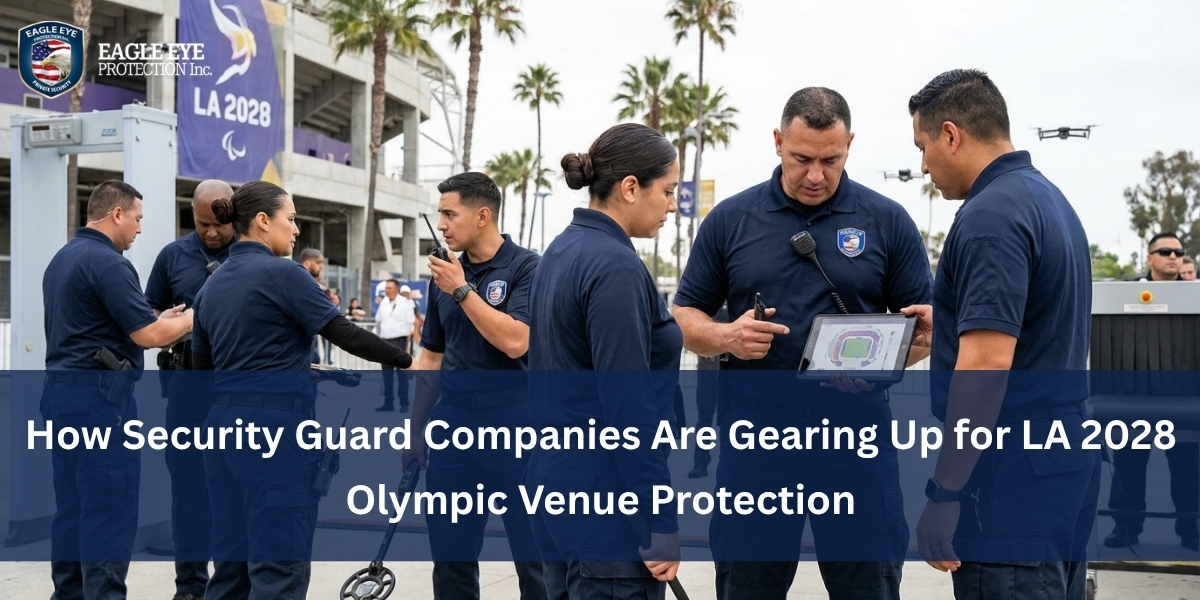
In this integrated approach, venue access control, credentialing verification, crowd flow and perimeter monitoring are usually handled by the privately employed security personnel. They check visitors, check tickets and credentials, regulate entry queues, and ensure security in the internal areas of venues. In the case of corporate hospitality areas, VIP zones and sponsor suites, close protection and control of restricted access is also provided by private security. This is a massive scope of responsibility considering the magnitude of the Games and security companies must have the staffing, training depth and coordination capability to fit the task.
How Security Guard Companies Are Training for 2028
Large-Scale Crowd Management Training
The skills needed to coordinate tens of thousands of visitors on one location are quite distinct and unlike those of a typical commercial security work. Such training entails the use of scenario based training which mimics high volume entry events and compressed crowd dynamics. The preparation of security guard companies LA Olympics 2028 has forced several companies to invest in large-scale crowd management training programs which previously was not a priority. Guards who have trained these skills in realistic scenarios are much better when it comes to the real high-volume events.
Threat Recognition and Counter-Terrorism Awareness
The international characteristics of the Olympics render the threat recognition training a critical element of the Olympic security preparation. This training is in line with the recommendations provided by federal agencies and adheres to standard models of major event security. This is among the most influential investments that security companies are making towards their 2028 preparation.
Credentialing and Access Control Protocols
The Olympics has a multi tier credentialing to regulate access to various venue areas, competition zones, and restricted areas. The main enforcement point of this system is the entrance of the venue and internal checkpoints, carried out by the private security guards. Awareness of the way the various levels of credentials operate, how to check them correctly and how to deal with credential challenges without causing bottlenecks takes certain and practiced education.
Venue-Specific Security Challenges for LA 2028
Stadium and Arena Coverage
The guards of these venues must deal with the visible aspects of security as well as the invisible of backstage and field-level security. The space and depth of the protection of the area, combined with the necessity to control the audience in large numbers, necessitates the planning of the deployment and the effective communication systems in this scale.
Technology Integration in Olympic Security Planning
Surveillance and Real-Time Monitoring Systems
Surveillance technology has become the backbone of modern Olympic security as the human security personnel have been given more area of coverage. Real-time feeds enable management to reassign staff according to emerging circumstances before they get out of control. The security companies that are investing in technology integration as part of 2028 preparation are developing a substantial operational advantage.
Credentialing and Access Management Tools
Contemporary credentialing systems are much more than paper badges and visual inspections. Biometric authentication, RFID reading, and built-in database access all facilitate quicker and more precise credential authentication at the portals. The private security firms operating at the Olympic sites must be able to work effectively with such systems. The technology saves the time taken in processing each attendee and minimizes the chances of fraudulent use of credentials.
How Businesses Near Olympic Venues Should Prepare
Increased Foot Traffic and Crowd Dynamics
Companies dealing with the Olympic Games done around the vicinity of the stadiums should anticipate dramatic growth in the number of pedestrians during the Games. This opens up blatant market potential but poses practical security and crowd control issues. The planning of security guard services at Olympics 2028 in Los Angeles may assist these businesses to prepare with customized coverage plans. It is much better to begin such discussions now and not in 2028.
Coordinating With Local Security Providers
Local security firms tend to have a better advantage in business than those who are far away, as they have an understanding of the local geography and the layout of the venue. Establishing liaison with a trusted local supplier prior to the Games forms a basis of good coordination during the Games time. This is particularly significant to the businesses that will be working throughout the games or having special events. Local knowledge, in an event this complicated geographically, is actually good.
What Makes an Olympic-Ready Security Company
Staffing Capacity and Surge Capability
The security at the Olympics must also have the capacity to deploy high numbers of qualified individuals at the same period of time in various locations. Firms that are understaffed will not be able to meet Olympic size contracts without cutting corners or hiring undertrained staff. The growth of licensed guard roster in 2028 is the type of long-term planning that Olympic-scale assignments demand. This ability query is among the most critical distinction in assessing suppliers to large-scale occasion securities.
FAQs
What is the role of the private security companies in the Olympics?
Access control to venues, credentialing checks, and crowd control, perimeter security, and protection of VIP areas are the role of private security companies.
What is the difference between security of Olympic venues and general event security?
The Olympic security is characterized by multi-venue coverage, the security of international dignitaries. It also elaborates credentialing, counter-terrorism awareness, and coordination with federal agencies.
What is the training of the security guards in the Olympics?
Large-scale crowd management training, threat awareness and counter-terrorism awareness is unique to large and multi-venue events.
What should businesses do to be ready for 2028 Olympic security?
Through reviewing the currently existing security plans with Olympic crowd dynamics in mind, liaising with local security providers. They are conversant with local venues, and developing coverage arrangements many years before the Games commence in 2028.
Conclusion
To the businesses that are in the vicinity of the Olympic venues, this is really the time to begin considering how 2028 will impact their security requirements. Security companies that are keen on contributing to the Games will have time to prepare but it will not be forever. Eagle Eye Pro is busy preparing the training, staffing, and coordination capacities to support the most significant event in a generation in LA. By acting now, businesses and venues have the lead time to construct a security plan that is really ready to face what 2028 actually will hold.