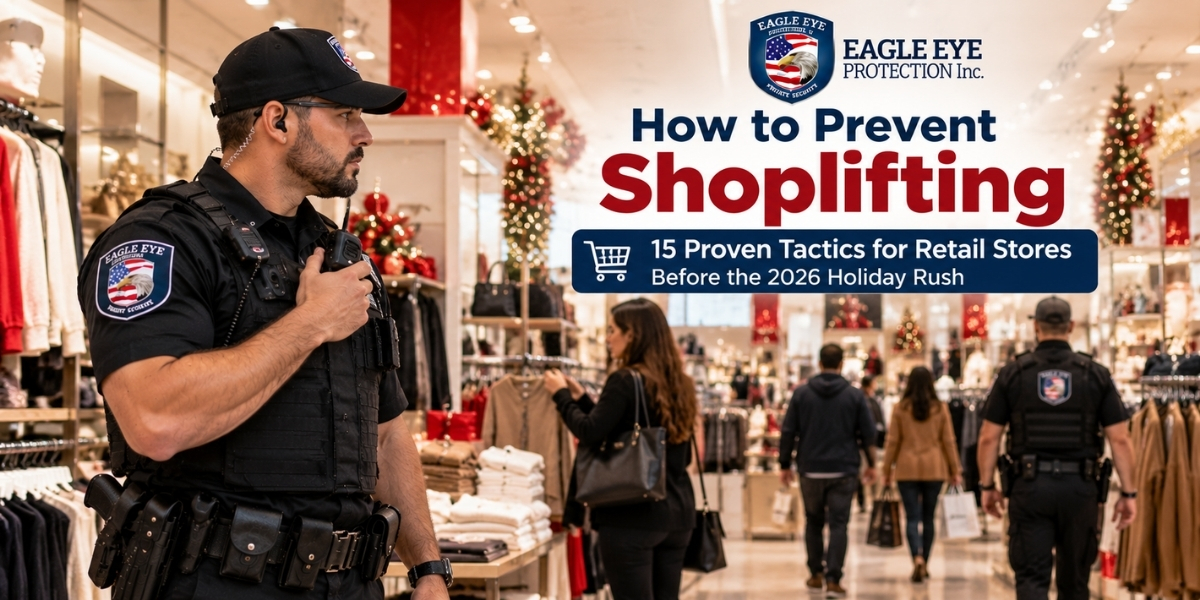
The retail sector loses tens of billions of dollars each year due to shoplifting. Retailers interested in knowing how to prevent shoplifting? should have a layered and proactive approach. Moreover, the most risky season of retail theft is the 2026 holiday rush of any type of store. Furthermore, the organized groups of retail crime organize themselves several months ahead of the season of holiday shopping. This is why planning should begin today before pedestrian traffic becomes more active and the staff members are stretched to their limits. These are 15 effective strategies that can provide your store with a solid defense until the rush.
Why the 2026 Holiday Rush Demands Extra Theft Prevention Preparation
The holiday seasons are associated with the influx of customers, the increased workload, and the increased number of theft possibilities. Moreover, opportunistic shoplifters and organized gangs are both more active at the busiest retail times. In addition, distracted employees, aisles congested and high turnover of merchandise are the conditions that thieves count on. Therefore, the stores that are not prepared in advance have the worst shrinkage figures of the whole year.
Tactic 1: Deploy Trained Loss Prevention Officers on the Floor
There is no better way to keep people off your floor than to walk a trained loss prevention officer on your floor. In addition, plainclothes officers intercept much more theft compared to uniformed guards since thieves do not recognize them. In turn, the combination of uniformed and plainclothes officers will result in the greatest possible deterrence on the level of the floor. This makes staffing of loss prevention your first and greatest priority investment prior to the holiday season.
Tactic 2: Position Security Guards at High-Risk Entry and Exit Points
Most attempts to shoplift start and end in success at the entry and exit points. More so, the presence of a security guard at the door is a good indication of the high risk nature of the environment to all would-be thieves. In addition, exit guards are able to monitor products and check receipts where allowed by policy. As a result, there is an instant decrease in walk-out theft cases in stores that have staffed exit and entrance points.
Tactic 3: Use Electronic Article Surveillance Tags
EAS tags raise alarm when the merchandise leaves the store without being deactivated at the checkout. Moreover, attaching pricey items also introduces a visual deterrent that scares off hiding efforts to a large extent. Besides, EAS systems can only work in the best scenario where guards act upon every alarm as soon as possible. As a result, a well-maintained EAS system can prevent casual thieves even prior to their initial attempt.
Tactic 4: Install and Actively Monitor CCTV Cameras Throughout the Store
Cameras capture events but will not deter theft until a person is paying attention to the live feeds. Moreover, the installation of cameras in the blind corners, dressing rooms, and the stockroom doors is a solution covering the most dangerous spots. In addition, the camera housings can also serve as a deterrent even when the camera is not capturing anything. Therefore, the deterrence effect is enhanced manifold by integrating active supervision with a high camera presence.
Tactic 5: Train All Staff to Greet Every Customer
An actual greeting reminds shoplifters that employees are alert and watching all. Moreover, robbers are particularly fond of those shops in which they do not feel observed and could hardly be addressed. Furthermore, regular customer recognition is among the most inexpensive yet most profitable prevention measures against theft. Therefore, employees who greet with confidence and look in the eye will minimize opportunistic theft without being confrontational.
Tactic 6: Keep High-Value Merchandise in Locked Cases
The locked cases provide an essential physical obstacle between a thief and your most profitable merchandise. Moreover, the necessity of staff assistance to see items slows the stealing process and the likelihood of being caught. In addition, locked screens also minimize the chances of grab-and-run cases during heavy hours of traffic. As a result, merchandise in a case will hardly be stolen in comparison to those on an open shelf.
Tactic 7: Reduce Blind Spots with Mirror Placement
Convex security mirrors remove the shadowy areas and angles, which the shoplifters are particularly sensitive to. Additionally, mirrors increase the area of coverage of each staff member and loss prevention officer on the floor. Further, their presence can be seen to remind the customers that the store is well surveilled in all directions. Mirrors are therefore a low-cost investment that will provide round the clock passive coverage without the need to have staff. Walk your whole store, then, as a thief, and put mirrors where the lines of sight become discontinuous.
Tactic 8: Implement a Two-Item Limit Policy in Fitting Rooms
One of the most popular places where merchandise is hidden when performing shoplifting activities is the fitting rooms. In addition, two-item limit policy where an attendant counts items greatly decreases the chances of concealment. In addition, the logging in and out of items by attendants establishes accountability which is too risky to maneuver by thieves. As a result, the rate of fitting room theft decreases significantly when there is an active and regular policy implemented daily.
Tactic 9: Use Inventory Management Technology to Track Shrinkage in Real Time
Inventory tracking in real time will tell you precisely when and where merchandise is going out of your store. In addition, scan data and physical counts may vary and indicate active theft before losses increase. As a result, retailers that have inventory technology can detect the theft patterns that would never be detected in time by manual counts. Thus, combine your point-of-sale and inventory systems and check shrinkage reports at least once a week.
Tactic 10: Secure Your Stockroom and Restrict Access to Authorized Staff Only
In the retail industry, almost 30 percent of the total retail shrinkage has been caused by employee theft, as industry research data indicates. Moreover, unprotected or unguarded stockrooms provide easy access to unpacked and untagged inventory to unauthorized people. In addition, records of keypad or keycard access generate accountability that minimizes internal theft in the long-term. As a result, one of the most underestimated investments in retail theft prevention is a secured stockroom.
Tactic 11: Add Visible Security Signage Throughout Your Store
Well-placed signs that indicate that the shop is under surveillance and that the shoplifters will be charged to keep away thieves. Moreover, there are signs around EAS systems, cameras, and fitting rooms that support the message at the most dangerous locations. Besides, the use of signs will convey a zero-tolerance policy without the need to invest in extra staffing. The informed shoplifters will, therefore, always avoid the stores with obviously visible and significantly displayed security signage.
Tactic 12: Coordinate Bag Checks and Receipt Verification
Checking of bags and verifying receipts at the exits provide an added level of accountability prior to the leaving of merchandise at the store. Moreover, the personnel who carry out checks ought to be trained to do so in a dignified manner and to all customers. In addition, the lack of consistency in enforcement raises biasing complaints and does not deter organized groups who anticipate exceptions. In turn, an effective exit verification policy based on uniform and professional approach to the matter will greatly minimize walk-out and concealment theft.
Tactic 13: Increase Staffing Levels During Peak Hours
The additional exposure of the personnel on the floor means more natural access to customers and monitoring. Moreover, thieves determine the level of staffing and then choose a target store and do not go to the stores that seem well-staffed. Additionally, proper staffing is a guarantee that the fitting rooms, stockrooms, and exit points are not kept without supervision. In turn, one of the most significant causes of the increases in the percentage of shrinkage caused by understaffing is during peak periods.
Tactic 14: Establish a Clear Shoplifting Response Protocol for All Staff
This is because the untrained personnel who fight the shoplifiers put the stores in risky positions that can be litigated. Additionally, a clear procedure instructs personnel on when they should be on watch, when to notify security and when to shut down. In addition, employees are not allowed to physically prevent or to hold a suspected shoplifter in any way at all. Therefore, a written response plan will ensure the safety of your employees, customers, and company. Thus, prepare and distribute your shoplifting response plan at least thirty days prior to the beginning of the holiday season.
Tactic 15: Partner with a Professional Retail Security Company Before the Rush
The trained guards, loss prevention skills, and proven systems are united by a professional retail security company. Moreover, collaborating early would make sure that guards know your store layout, employees, and areas of high risk prior to prime time. Furthermore, professional security organizations have the ability to increase the number of deployed scaled guards as well as reduce the number when your traffic patterns demand it. As a result, retailers who have a professional security partner always beat competition in terms of shrinkage during the holiday period.
FAQs
How would you best deter shoplifting in a retail outlet?
Trained loss prevention personnel, EAS tags, and active cameras are the best combination to form the most effective deterrence. There is no single strategy that can avert shoplifting as well as a multi-layered strategy can in your whole store.
When should retailers start preparing for holiday season shoplifting prevention?
The retailers ought to be in possession of all prevention strategies by the latest of the month of October. Organized theft gangs start working in November and therefore planning needs to be done long before November.
What is the role of EAS tags in the way to prevent shoplifting?
EAS tags raise alarms at the exits when the merchandise is not deactivated via the check out process. EAS systems, when used together with active guard response, thwart a high percentage of concealment-based shoplifting attempts.
Conclusion
The 2026 holiday rush shoplifting prevention will demand preparation, overlay strategies, and professional assistance. It is not about knowing how to stop shoplifting but it is about doing it before the season starts when it is not yet time to start incurring losses. Additionally, the retailers which are the first to prepare, always experience the least amount of shrinkage during the busiest season. Eagle Eye Pro is an established retail security firm in Los Angeles, offering trained guards. After all, knowing how to avoid shoplifting is the most lucrative choice any retailer could make this year.