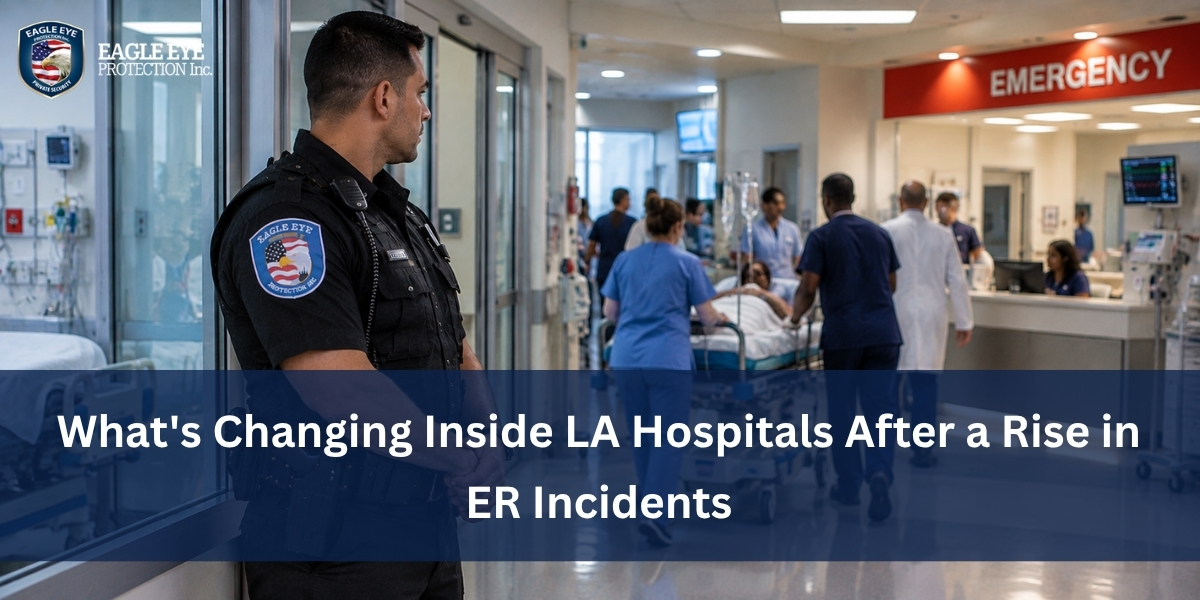
Disruptive incidents have increased in emergency rooms throughout Los Angeles in recent years. Employees complain of more verbal and, in certain instances, physical fights as well. This change has compelled hospital administrators to rethink the way they deal with safety. Most facilities are increasingly spending more on professional healthcare and hospital security Los Angeles teams: they offer direct services. This article looks at what’s actually changing inside hospitals in response.
Why ER Incidents Have Been Rising
Longer Wait Times Are Fueling Frustration
There has been an increasing number of patients in the emergency rooms in the city without a corresponding increase in staff. This incompatibility results in extended waits, and extended waits in turn imply more frustrated, anxious patients. Sometimes anger erupts into fights against nurses, doctors or front desk staff. Knowledge of this underlying cause will assist in understanding why incidents have been on the rise and not flat. It is still challenging to tackle wait times head on, and this is one of the reasons why security has intervened.
Mental Health and Substance-Related Visits Have Increased
Hospitals report that it has to deal with more patients who come to the hospital in a mental crisis or under the influence. Such cases occasionally demand a varied type of reaction as compared to the common medical emergencies. The personnel who are only trained on clinical care lack the tools to handle this safely. Hospital security Los Angeles personnel are more and more assisting personnel in these particular, delicate situations. This trend is indicative of a larger trend that hospitals are experiencing in most emergency departments.
Family Members Under Stress Sometimes Escalate Situations
It is hardly ever the patient himself who makes the tension within a crowded emergency room. Sometimes, the family members observing a loved one in pain take their fear and anger, and project it outward. This stress may build up in a very short period of time, particularly when it is coupled with waiting long hours or vague information. Understanding that these events may have bystanders, and not patients, is important in preventing them. This is a wider pattern that hospitals are modifying their approach with in particular.
What Hospitals Are Actually Changing
Increasing Visible Security Presence in Waiting Areas
Most hospitals are posting guards in the ER waiting rooms as opposed to posting them at entrances only. This physical presence will aid in defusing tension before it escalates into a more serious incident. The security of healthcare and hospitals in Los Angeles has placed providers in areas where frustration is likely to be concentrated. This presence can be observed by patients and families and simply by being seen can alter behavior. This change is indicative of hospitals evolving to learn the actual source of incidents in its facilities.
Training Security Staff in Trauma-Informed De-escalation
Basic security education does not equip the guards with the emotional nature of a hospital environment. A growing number of hospitals are making security teams undergo training related to healthcare settings. This also involves the knowledge of the influence of fear, grief, and pain on the way people act under stress. This type of training of healthcare and hospital security Los Angeles teams is more responsive. This specialized training is one of the larger changes that are occurring within the industry.
Coordinating More Closely With Clinical Staff
Security and clinical staff used to work relatively independently, with the only communication between them being the emergence of issues. It is becoming a day-to-day practice in hospitals to establish a closer coordination between these teams. Nurses can now alert security on any issue that may be of concern before things deteriorate into actual problems. This is an active communication that allows one to prevent an incident as opposed to one reacting after it has occurred. Greater interdependence of these teams has been a real concern to most facilities.
Physical Changes Hospitals Are Making
Redesigning Waiting Areas to Reduce Tension
Other hospitals are also reconsidering waiting room plans to cut down on congestion and enhance visibility. Improved spacing and better communication regarding wait times are both ways of reducing patient frustration to some degree. Physical design changes sometimes fall on the consultants of healthcare and hospital security Los Angeles. This indicates that the security thinking has become more than that of guards to its real facility design decisions. Even minor changes in layout can significantly decrease the strain which causes incidents.
Installing Panic Buttons and Silent Alarm Systems
Discrete panic buttons are becoming more and more accessible to staff members in patient care areas. These systems enable nurses or front desk personnel to seek assistance without making a situation appear to get out of control. This technology provides employees with an actual safety net in times when they feel unsafe. This is not a case of an optional add-on that is being treated as a safety standard at hospitals. This modification is based on experiences with accidents when the assistance was too slow.
Adding Metal Detection at Emergency Room Entrances
Certain hospitals in LA have implemented metal detectors at the ER entrances, rather than main lobbies. This transformation is a solution to the fear of weapons coming in at the time when there is increased emotional pressure. This screening process is controlled by the security teams at the hospital and healthcare facilities in Los Angeles at these special points of entry. The addition marks a significant change in facilities where previously only the main hospital entrances were screened. It portrays the seriousness with which the hospitals are now taking ER-specific risk.
Staffing Changes Beyond Just Adding More Guards
Hiring Guards With Healthcare-Specific Experience
Hospitals are more and more demanding security staff who have previously worked in a healthcare establishment. This experience implies that guards are already familiar with the hospital rhythms, behavior of patients, and urgency of care. Los Angeles healthcare and hospital security providers having this background will adjust to hospital settings more quickly. This staffing bias indicates that hospitals are aware that generic security experience does not entirely translate in this case. Specialization experience has turned into a hiring requirement and not a bonus.
Scheduling Guards Around Known Peak Hours
Hospitals are examining data on incidents to determine the hours that are characterized by the most tension and conflict. Staffing has now become a common occurrence particularly at these specified peak-risk time windows. This dedicated strategy utilizes security resources more efficiently in comparison to the flat and unvarying staffing status. Based on such data, the coverage by healthcare and hospital security Los Angeles teams is scaled. This change of data-driven scheduling is a more advanced practice compared to earlier.
How Staff Wellbeing Factors Into These Changes
Reducing Burnout Among Clinical Staff
The stress and burnout levels increase over time among nurses and doctors who have to deal with frequent confrontations. Better security assistance will allow decreasing the level of emotional burden that clinical staff have to experience during shifts. Hospital administrators are becoming more aware of this linkage between security and the wellbeing of their staff. This retention issue is one that is now framed in terms of healthcare and hospital security Los Angeles investment. Staff wellbeing protection has become at least as much of a driver as physical safety.
Improving Staff Confidence During Difficult Interactions
The information that the security is present alters the attitude of clinical personnel to the possible tense interactions with patients. This trust enables the nurses and the doctors to concentrate on care and not on their safety. Staff report to be more capable of establishing boundaries when backup is really present in the vicinity. This mental advantage is to be set against the more apparent physical security enhancements that security brings. This is becoming a significant, quantifiable advantage that is being realized as worth investing in at hospitals.
Why These Changes Are Happening Now Specifically
Increasing Public Attention on Healthcare Worker Safety
There is more violence against healthcare workers nowadays. This focus has compelled hospital administrators to consider the problem a real priority. This greater, national awareness change is reflected in healthcare and hospital security Los Angeles investment. Hospitals where treating occasional incidents was deemed unavoidable have now viewed them as preventable. This new outlook has contributed to much of the new investment into tougher security.
Regulatory and Accreditation Pressure Increasing
Hospitals are increasingly being required by the healthcare accreditation bodies to show real safety planning and documentation. This strain provides more incentive to hospital administrators to take security investment seriously. Those facilities that do not demonstrate proper planning are not only prone to accreditation problems but also face real liability risks. This control aspect brings in an extra layer of importance other than a desire to defend employees and patients. Security planning in hospitals is being treated by hospitals as a compliance issue and not necessarily a safety issue.
FAQs
Why has there been an increase in ER incidents at LA hospitals?
Increased wait times, escalating mental health visits, and the stressed family members are also a major contributor. All these factors add up to cause increased tension in busy emergency departments.
What is the current form of training of the security guards in the hospitals?
Numerous of them get trauma-informed de-escalation training tailored to healthcare settings and scenarios. Such training assists guards to react with due sensitivity to emotionally charged situations.
Do hospitals introduce new technology to deal with such incidences?
Yes, panic buttons and the silent alarm systems are getting common in most of the facilities. Other hospitals have gone to the extent of installing metal detectors in entrance points of the ER.
What is the reason why hospitals are recruiting guards that have healthcare experience?
This experience guides guards to learn about hospital rhythms and patient behavior faster. It is a move towards viewing hospital security as non-specialized guard work.
What can these security changes do to help hospital staff, and not just the patients?
Enhanced security service minimizes burnout among staff and builds confidence when dealing with challenging encounters. This interrelationship between safety and personnel welfare is gaining acceptance among administrators.
Is there a perception that patients feel more secure when visiting the hospital?
Yes, most hospitals have had more noticeable security especially in emergency room waiting bays. The purpose of this presence is to make the environment less tense, and not to scare away the visitors.
Final Thoughts
The hospitals in LA are instituting actual, practical changes in reaction to the increasing ER cases. This shift can be seen in the increased presence of security, specialized training, and improved technology. Eagle Eye Pro collaborates with healthcare facilities to help meet these changing safety requirements. Such changes will eventually ensure the safety of the patients and the staff that takes care of them. Get in touch with Eagle eye Pro today and talk about security in your healthcare facility.