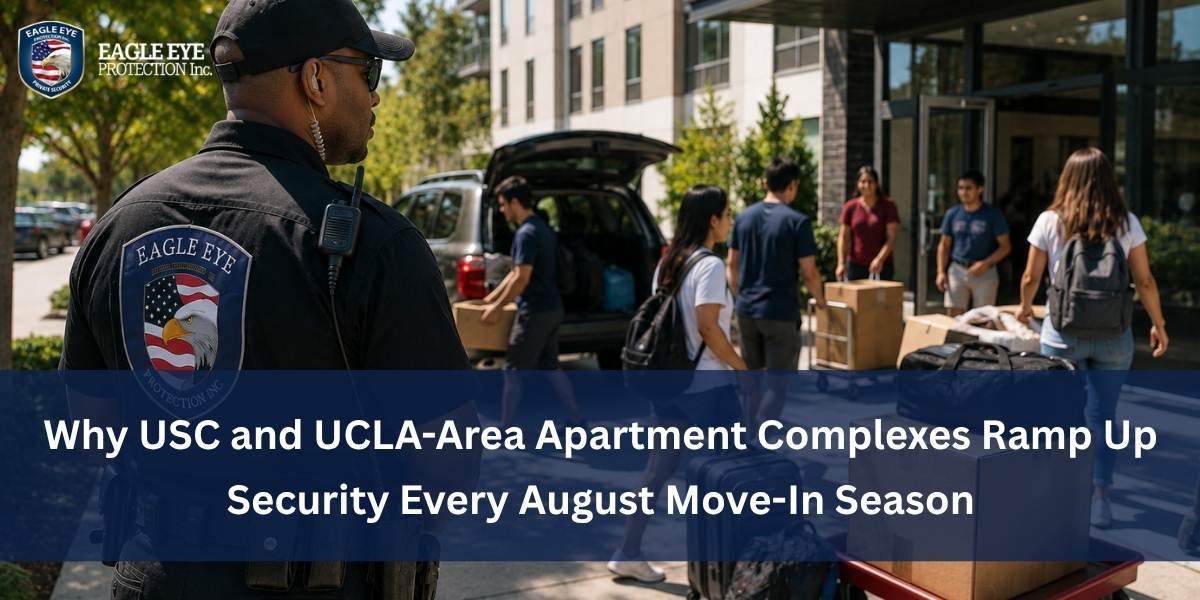
Each August, USC and UCLA campuses are overwhelmed with thousands of students moving in. This influx poses foreseeable pressures, which property managers need to plan ahead of each year. Los Angeles move-in season Student housing security requires the managers to be proactive in their planning. This guide covers the reasons behind complexes increasing coverage and the reality that works. This reasoning of these seasonal investments will be clear by the end.
Why August Creates a Security Surge
Move-in season gives massive pedestrian traffic within a limited and foreseeable time period every year. USC off campus housing is usually available by mid-August each year. At the same time, the UCLA housing move-in tends to follow a bit later, further stretching the wave. This is a focused timing such that properties will encounter a number of full weeks of high risk. This timing will aid property managers to plan staffing and security coverage.
The Unique Risks of Student-Heavy Neighborhoods
Certain, well-documented seasonal security issues can be observed in student neighborhoods around USC and UCLA. Such crimes as car break-ins and package theft are still considered especially popular. Moreover, a lot of first-year students do not have any experience of identifying the typical risks in the city in terms of their safety. Parents who drop students are also adding more faces during weekends which are already hectic. All these factors make student housing security Los Angeles move-in truly more arduous.
Learning From University Safety Programs
Both USC and UCLA have extensive safety infrastructure investments. The Department of Public Safety at USC patrols the area with safety ambassadors visible in the neighborhoods. UCLA also has Community Service Officers and special late-night escort services in the vicinity. Off-campus housing enjoys the result of studying these models of safety programs that are well-established and supported by the university. Adding university security with that of the private security establish stronger, more comprehensive security of neighborhoods.
Why Off-Campus Complexes Cannot Rely on Campus Police Alone
University campuses have a typical area of jurisdiction of campus police that includes only the university property and areas that are directly adjacent to it. In some cases, off campus apartment complexes may lie completely outside such official patrol areas altogether. This loophole makes the private properties to take care of their own dedicated security cover. This particular coverage gap should be addressed by the student housing security Los Angeles move-in efforts. When property managers are knowledgeable about this boundary they will budget their security more realistically.
Propped Doors and Access Control Failures
One of the most frequent move-in season vulnerabilities overall is propped-open doors. Students hold doors open to ease of movement as they take boxes and furniture up and down the stairs many times. The practice temporarily compromises access control in place to ensure buildings are secure. UCLA housing policies particularly caution students against improper sharing of key card access. Teaching new residents of this risk prior to move-in actually diminishes incidents considerably.
Package Theft During the Move-In Rush
Also known as porch piracy, package theft is particularly a major problem on the weekends of the move-in, city-wide. Furniture, electronics, and dorm supplies are ordered at the same time in the case of new students. Deliveries are stacked in corridors and lobbies, and residents have to pick them up. Obvious security is a big deterrent to this form of casual opportunistic package theft. Secure package rooms or lockers are also significant in minimizing this particular seasonal vulnerability.
Verifying Movers, Parents, and Unfamiliar Visitors
The move-in weekends introduce new faces of people in buildings in short durations. Access is needed by parents, siblings, movers and delivery drivers. Without any trained personnel, it would truly be hard to differentiate between legitimate visitors and potential threats. Clear check-in procedures would assist in making sure that the staff are able to check on visitors effectively during busy times. This check-up exercise safeguards residents and their property during hectic weekends.
The Role of Trained Security Guards During Move-In
Human element automated systems cannot be replicated by trained security guards. Guards will have access to monitor entrances and identify people, as well as to respond to suspicious persons in a timely manner. In contrast to cameras, guards are proactive in deterring issues before they develop into actual incidences. Their experienced staff are aware of the special cadences of student housing settings in particular.
Coordinating Security With Leasing and Maintenance Teams
The use of coordination among the security, leasing and maintenance personnel is essential to effective move-in security. Move-in schedules would be shared with security teams to allow them to predict the times when traffic would be the most active. The maintenance personnel are also expected to report any doors or access problems that have been propped. This team practice will make sure that no one department has to bear the full responsibility of safety. Properly coordinated teams work more efficiently and quickly in periods when there are actually hectic weekends of move-in.
Lighting and Visibility Improvements Before Students Arrive
During evening move-in operations around campuses with high traffic, poor lighting is particularly dangerous. Visiting the properties prior to the commencement of the move-in season will assist in revealing areas that lack good lighting. The opportunistic criminal behavior is deterred by replacing burnt-out bulbs and installing motion-activated lighting. Better visibility also assists new students to find their way through the unfamiliar buildings even when it is dark. This is a relatively inexpensive upgrade that makes properties in general a lot safer during peak hours.
Communicating Safety Expectations With New Student Tenants
The open communication prior to move-in day can help in avoiding numerous typical, completely preventable safety issues. Send new tenants welcome packages on building security and house regulations. Particularly, discuss door propping of addresses, package pick-ups, and contact information in the event of an emergency in a fairly straightforward manner. Also, discuss visitor policies, and any gate code or key fob instructions. Educated students are more likely to adhere to safety precautions during the whole lease.
Why Parking and Traffic Management Matter Too
Move in weekends cause major parking and traffic jams around areas that have a high number of students across the city. Trucks parked in front of driveways and other visitor vehicles vying over scarce parking space block parking lots. Such congestion is irritating to the inhabitants and can produce truly unsafe conditions in the vicinity as a pedestrian. Parking logistics coordination in advance will help to reduce the stress on tenants and the property staff to a considerable extent. Obvious signs and special loading lots also contribute to a much smoother traffic flow.
How Neighborhood Character Shapes Security Planning
The security planning is vulnerable to different considerations in the neighborhoods of USC and UCLA, respectively. The area around the USC (University Park) has been traditionally in need of heavier commitment to visible patrols. Westwood Village, which is close to the UCLA, enjoys more foot traffic and lighting. These neighborhood characteristics should be closely reflected in the student housing security Los Angeles move-in planning. Knowing your precise location aids property managers to distribute resources better in general.
Building Trust With Student Residents Over Time
The best way security presence is achieved is when students trust those in charge of their security. Familiar, welcoming guards establish a friendly rapport that helps students to open up and report. This trust is particularly helpful in stressful, first-weeks of the semester, when people are not familiar with each other. Invested properties in relationship-building and security achieve high tenant retention. Having trust in place, all further security interactions become much more efficient and simplified.
Preparing Parents for a Smooth Drop-Off Experience
There is also an overall advantage of transparent, immediate property communication by parents who drop off their students. Pre-sending parking instructions and check-in procedures will help minimize the confusion on the arrival day. Security is a particular concern one of the main questions many parents will raise prior to making their final decision of where to house their student. Proactively answering these questions will instill confidence, and help develop the overall reputation of the property. The positive experience of a well-organized drop-off will resonate with the whole property in general.
Budgeting for Seasonal Security Coverage
Other times property managers are reluctant to spend on extra seasonal security cover initially. Nevertheless, a comparison between the cost of security and the losses that can be caused by theft or liability takes a new turn very soon. One serious incident can be many times more expensive than weeks of guard coverage. When you create a seasonal security into your annual budget, you avoid such financial surprises in the future. A variety of providers also provide flexible schedules and cover in shorter, focused periods.
Why Eagle Eye Pro Supports Properties During Move-In Season
Eagle Eye Pro is aware of the special strains that are experienced in the areas surrounding busy colleges. Their guards are trained to offer visible security and visitor validation, as well as quick response to incidents. The advantage of having professionals with the expertise of the student housing seasonality is beneficial to property managers. The collaboration with a well-established provider will relieve a lot of stress during an otherwise busy season. Have in mind to book an appointment much earlier than your next move-in weekend ever comes.
FAQs
Why does student housing security in Los Angeles increase every August?
The congested commuter traffic around USC and UCLA poses foreseeable, seasonal security threats.
What is the risk of the most common move-in season security?
The most common seasonal issues, in general, are propped-open doors and package theft.
Do security guards effectively lower the incidents during the move-in season?
Yes, the presence of guards, which is visible, is a strong detriment to stealing and gaining illegal access to the building, in general.
What should property managers do prior to the arrival of students?
Arrange additional security and pre-announce safety expectations in a more comprehensible way.
Is seasonal security something that small properties should invest in?
Yes, even smaller complexes can enjoy temporary cover on peak move-in weekends.
Conclusion
There are real seasonal liabilities in the area with propped doors, package theft, and strangers. This synchronization of security, leasing and maintenance personnel would go a long way in enhancing the overall preparedness of the property on a city wide basis.
Human presence technology alone cannot be effectively replicated by trained guards. Projecting the future and developing trust in tenants further enhances seasonal preparedness of any property. Eagle Eye Pro assists real estate around USC and UCLA to survive this season of stress. Being ready today is a way of safeguarding both your property as well as your new students.