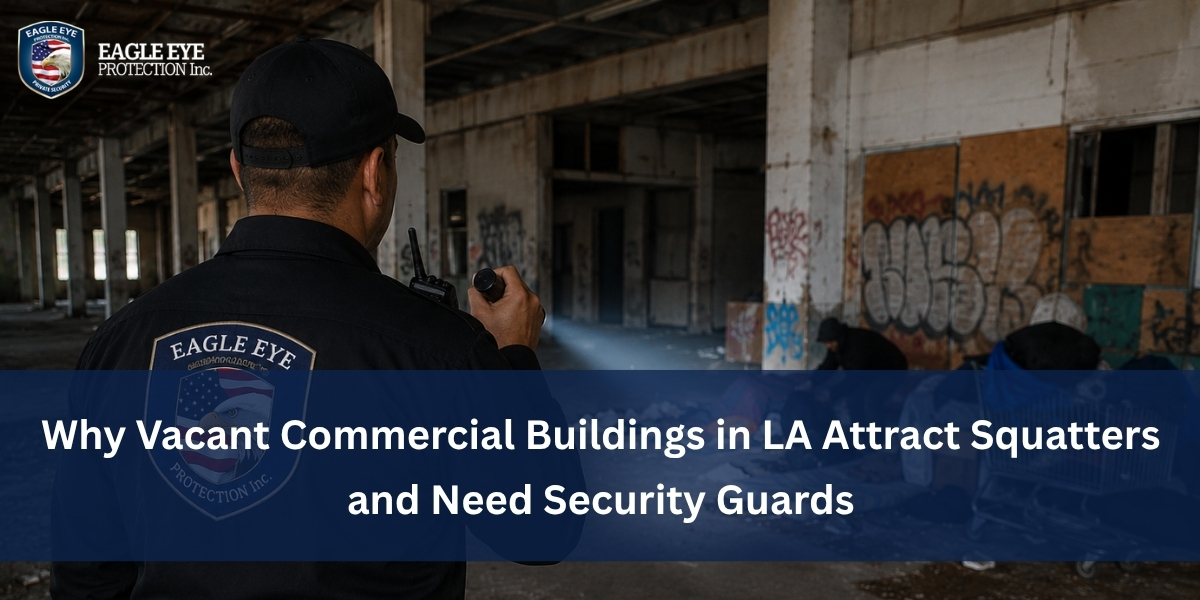
There are empty business properties around Los Angeles at the moment. Others are waiting to get new tenants, some are renovating, and others are being sold. But there is a vacuum that creates a serious squatter opportunity. After someone has moved in, it may take months to get them out in California. That is precisely why the presence of security guards vacant commercial buildings Los Angeles is necessary. This guide explains why unwanted occupants target unoccupied properties and how guards deter this.
Why Vacant Buildings Are Such Easy Targets
We can begin with the reality property owners face today. The legal mechanism for evicting squatters in California is biased toward being slow rather than fast. By 2026, the maximum number of days allowed as a notice period has risen to 90 days in most instances. A squatter may have three months in possession of a property. A formal eviction process can only commence after that.
With such a long history, empty buildings are particularly appealing to opportunistic inhabitants. As soon as an individual settles in and changes the locks, it becomes difficult to evict them. The property owners are required to issue an adequate notice followed by filing an unlawful detainer lawsuit. In the process, the building will be generating zero income for its owner. In the meantime, the daily damage, unpaid utilities, and liability risks are mounting.
How Squatters Actually Get In
An entry method can help understand the importance of prevention. Squatters will seldom force down a front door during broad daylight. They instead seek more covert means within.
Unsecured side doors and loading docks.
There are usually other entrances to commercial buildings other than the main entrance.
Broken windows
When squatters get indoors, they usually seal such holes with their own hands so they can escape notice.
Counterfeited keys or imitated keys.
In some cases, past employees, contractors, or previous tenants may still have keys to the building. These keys are sometimes passed to individuals with no entitlement to use them. This risk remains open without rekeying after a vacancy.
Word of mouth among unhoused communities.
Unoccupied buildings that can be left unmonitored are easily known in the local network. One individual has a convenient point of entry, and the word will spread. In a few weeks, one empty house will be filled with inhabitants.
The trend of all these approaches is the same. Structures that lack an apparent human presence and activity are identified and targeted.
The Financial Cost of an Unprotected Building
Several owners do not know the true cost of a vacancy that is not secured. It helps to walk through the figures, frankly speaking.
First is the direct cost of removal. Court filings, legal fees, and lost rent add up quickly in the course of a dispute. One squatting case can easily cost thousands of dollars. In the meantime, the property is not put to any use during the months of the whole process.
Then there’s property damage to consider as well. Squatting conditions are also characterized by modified plumbing, electrical interference or modification, or changes in structure. The fires that begin due to improvised heating or cooking are a real, serious threat. Certain owners have gone back to a property that needs a lot of expensive repairs.
Common Owner Mistakes That Invite Trouble
Many vacancy issues can be linked to a few preventable errors. Understanding these trends can help property owners better secure their properties.
Assuming a locked door is enough protection.
A single lock hardly deters a persistent burglar. There are several points of entry, old hardware, and battered locks; all are points of vulnerability.
Waiting too long between property checks.
Some owners visit vacant buildings only once every couple of weeks. That loophole provides squatters with ample opportunity to establish themselves unnoticed.
Failing to rekey after a tenant leaves.
The circulation of old keys is an unnecessary risk that is easy to avoid. This gap is sealed by rekeying right after vacancy starts.
Ignoring minor damage or vandalism.
At first glance, a small broken window may not appear to be much. But unattended destruction is usually a good indication that no one is on the lookout.
Relying only on cameras without human patrols.
Cameras do not prevent incidents; they capture what occurs. Footage is post facto evidence, without a person responding in real time.
What Guards Actually Do at Vacant Properties
This is where dedicated security guards come in. The following is what such protection usually resembles in practice.
Regular walkthroughs and perimeter checks.
The building is physically inspected by guards on regularized rounds and randomly. They inspect all doors, windows, and fence lines to determine whether they have been tampered with. This regular attendance will detect issues before they become an issue.
Verifying locks and access points daily.
A door locked today does not mean that it will be locked tomorrow. Guards verify locks, record damage, and indicate forced entry. Quick reporting means repairs occur before anyone gets permanent access.
Monitoring for early signs of occupation.
Security guards in vacant commercial buildings in Los Angeles can identify red flags that would otherwise go unnoticed by ordinary people. Items left behind, disturbed dust, or new locks are all indications of trouble. Early detection of these indicators will help to avoid the temporary invasion of the territory.
Removing trespassers before rights attach.
This is a critical point under California law. Police can normally remove someone who is found trespassing. But when one has settled, then it becomes a long civil eviction. Guards who detect offenders before they reach the trespassing category retain them in that category.
Deterring theft of building materials and fixtures.
Unoccupied buildings are not only the targets of squatters, but also metal thieves. Resale value is in copper wiring, plumbing fixtures, and HVAC units. An apparent guard will deter such opportunistic theft too.
Coordinating with police for trespassing calls.
Guards are quick when one is caught on the premises without authorization. They call the police as soon as they intrude, and trespass remains legal. Such speed can be the difference between a swift removal and months of court proceedings.
Why the Legal Timing Matters So Much
This is the fact that every property owner must know. The law of trespassing and squatting is very different in California. Trespassing is a criminal issue that the police can resolve on a case-by-case basis. Once established, squatting is a civil issue that has to be pursued through the courts.
Such a change normally occurs after an individual proves that he/she is residing there. Personal belongings, modified locks, or utilization can indicate residence. When such a threshold is crossed, owners will be subjected to notice terms and potential court filings. Recent developments saw the extension of some of the notice periods to 90 days.
Building a Complete Vacancy Security Plan
Guards are most effective with other basic protective measures. Immediately boarding broken windows eliminates a conspicuous point of entry. Motion-triggered lights eliminate the dark hideouts of squatters and thieves. Cameras provide documented evidence for any subsequent events.
The locks are rekeyed when a property is empty, which is easy to do. There should never be ongoing access to former tenants, contractors, or employees. Frequent landscaping and exterior maintenance are also more important to the owners than they can imagine. Anyone who walks by an overgrown and neglected property will tell him that it is abandoned.
What to Look for When Hiring Vacancy Security
Selecting the appropriate security company is very important in this kind of work. Ensure that the company has a valid Private Patrol Operator license. Inquire about experience in dealing with vacant or unoccupied commercial premises. This is not the same as manning a business that is going on.
Find out the frequency of patrols and whether the timing is unpredictable. Squatters and thieves can work at predictable hours. Ask for clear reporting after each patrol, with photos where applicable. Lastly, inquire about the speed of the company to react in the event of the intrusion being detected.
How Eagle Eye Pro Protects Vacant LA Properties
At Eagle Eye Pro, our business model is to secure empty and unoccupied commercial premises. Our guards conduct regular, randomized patrols of entrances, fencing, and interior areas. We locate and document vulnerabilities until they are entry points to anyone. All security guards vacant commercial buildings Los Angeles are trained to identify any early signs of attempted occupation. If trespassing does take place, we liaise swiftly with the police, as long as the scenario is not complex. Our comprehensive reporting also provides owners with a clear report on insurance and legal matters.
FAQs
Why do squatters attack empty commercial premises?
Unoccupied buildings are sometimes left unattended for long periods. Squatters seek accessible access and the non-existence of supervision.
What is the maximum time duration that a squatter can be in California?
The time of giving notice has increased to a maximum of 90 days before eviction can commence. Overall, the time of full eviction through the courts might be much longer.
What is the frequency of patrolling of a vacant property?
The size, location, and riskiness of the property determines the frequency. Most of the owners prefer several randomized patrols per day and night.
What about existing squatters on my property?
Call an experienced lawyer and leave the issues to him/her. Forced removal or illegal lockouts can incur severe legal liability instead.
Final Thoughts
Unoccupied commercial properties constitute actual financial risk throughout Los Angeles nowadays. The legal process in California renders prevention much more valuable than an after-the-fact removal. And that is precisely why the security guards for vacant commercial buildings in Los Angeles are so significant.
Timely identification makes the situation straightforward and safeguards the owners against protracted lawsuits. Eagle Eye Pro takes pride in patrolling empty and unfilled properties across Los Angeles and ensuring security with trained patrol teams. Since prevention is always the best cure to a squatter problem, it is always important to ensure that one does not begin at all.